Introduction
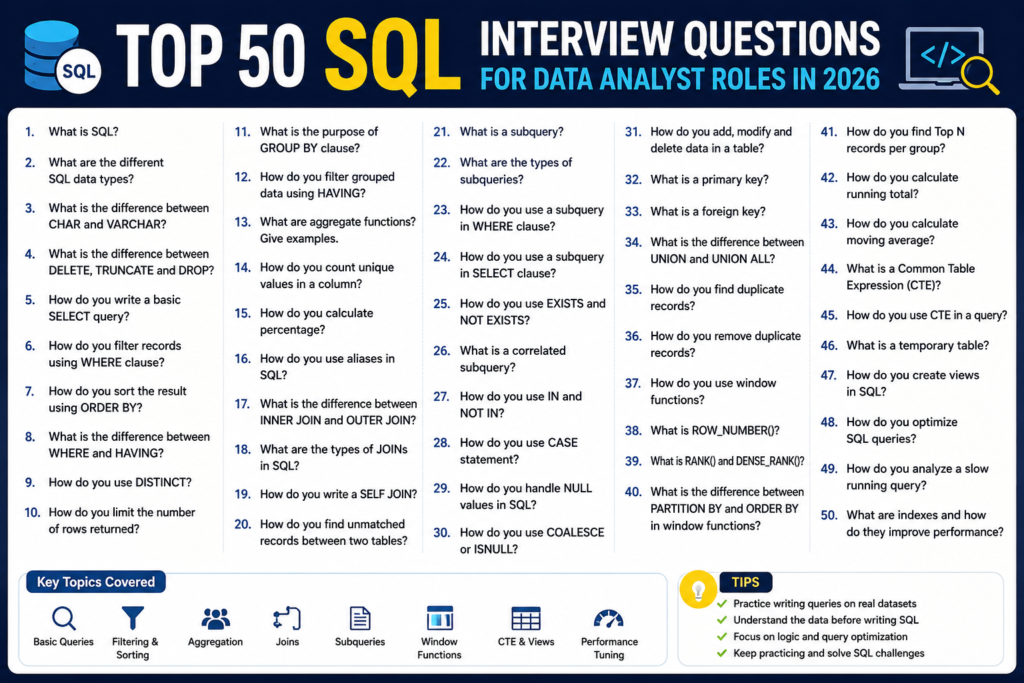
Sql interview questions data analyst 2026 are important for freshers and working professionals who want to enter data analyst, MIS analyst, business analyst, or reporting analyst roles. SQL is one of the most common skills tested in data analyst interviews because companies need people who can pull, filter, join, clean, and summarize data from databases.
This guide covers the top 50 SQL interview questions for data analyst roles in 2026. You will learn basic SQL questions, joins, aggregate functions, subqueries, window functions, case statements, practical interview scenarios, tools, and salary scope.
Why SQL Is Important for Data Analyst Roles in 2026
SQL is still one of the most valuable skills for data analyst jobs because most business data is stored in databases. Excel and Power BI are useful for reporting, but SQL helps analysts collect the right data before building reports or dashboards.
In interviews, recruiters do not only ask theory. They usually check whether you can solve real business problems. For example, they may ask you to find top-selling products, monthly revenue, duplicate records, inactive customers, or department-wise employee counts.
Sql interview questions data analyst 2026 usually test these areas:
| Skill Area | Why It Matters |
|---|---|
| SELECT Queries | To fetch required columns |
| WHERE Clause | To filter records |
| GROUP BY | To summarize data |
| JOINs | To combine multiple tables |
| Subqueries | To solve layered problems |
| Window Functions | To rank and compare rows |
| CASE WHEN | To create business conditions |
| Data Cleaning | To handle NULLs and duplicates |
If you are preparing for a data analyst interview, SQL should not be treated as an optional skill. It is a core skill for most analytics roles.
Tools You Should Know Before SQL Interviews
Before practicing sql interview questions data analyst 2026, understand the tools commonly used in training and workplace environments.
| Tool | Use |
| MySQL | Beginner-friendly SQL database |
| PostgreSQL | Popular open-source database |
| SQL Server | Used in many companies |
| Oracle SQL | Common in enterprise systems |
| Google BigQuery | Cloud analytics database |
| Excel | Data checking and validation |
| Power BI | Dashboard and reporting |
| Tableau | Data visualization |
For beginners, MySQL or PostgreSQL is enough to start. Once you understand SQL logic, you can work with SQL Server, Oracle, or BigQuery with small syntax changes.
Salary Scope for Data Analyst Roles in 2026
SQL alone may not guarantee a high salary, but it improves your chances when combined with Excel, Power BI, Python, and dashboard skills. Entry-level data analyst salaries in Bangalore and other major Indian cities usually depend on company type, projects, communication skills, and tools knowledge.
| Level | Typical Skill Set | Approximate Salary Scope |
| Fresher | Excel + SQL basics | ₹3.5 LPA to ₹6 LPA |
| Junior Analyst | SQL + Excel + Power BI | ₹5 LPA to ₹8 LPA |
| Data Analyst | SQL + Power BI + Python basics | ₹7 LPA to ₹12 LPA |
| Senior Analyst | SQL + BI + Python + business reporting | ₹12 LPA+ |
For better interview results, do not only memorize sql interview questions data analyst 2026. Practice writing queries on sample datasets like sales, employees, orders, customers, and products.
Top 50 SQL Interview Questions Data Analyst 2026
1. What is SQL?
SQL stands for Structured Query Language. It is used to store, retrieve, update, delete, and manage data in relational databases.
2. What is a database?
A database is an organized collection of data stored electronically. In analytics, databases store customer, sales, product, employee, and transaction data.
3. What is a table in SQL?
A table stores data in rows and columns. Each row is a record, and each column represents a field such as name, date, price, or department.
4. What is a primary key?
A primary key uniquely identifies each row in a table. It cannot contain duplicate or NULL values.
5. What is a foreign key?
A foreign key connects one table to another table. It usually refers to the primary key of another table.
6. What is the SELECT statement?
The SELECT statement is used to fetch data from a table.
Example:SELECT name, salary FROM employees;
7. What is the WHERE clause?
WHERE is used to filter records based on a condition.
Example:SELECT * FROM employees WHERE department = 'Sales';
8. What is ORDER BY?
ORDER BY sorts query results in ascending or descending order.
Example:SELECT * FROM sales ORDER BY revenue DESC;
9. What is GROUP BY?
GROUP BY groups rows with the same values and is commonly used with aggregate functions.
Example:SELECT region, SUM(sales) FROM orders GROUP BY region;
10. What is HAVING?
HAVING filters grouped data. WHERE filters rows before grouping, while HAVING filters after GROUP BY.
Example:SELECT region, SUM(sales) FROM orders GROUP BY region HAVING SUM(sales) > 50000;
11. What is COUNT?
COUNT returns the number of rows.
Example:SELECT COUNT(*) FROM customers;
12. What is SUM?
SUM adds numeric values.
Example:SELECT SUM(amount) FROM payments;
13. What is AVG?
AVG returns the average value.
Example:SELECT AVG(salary) FROM employees;
14. What is MIN and MAX?
MIN returns the smallest value. MAX returns the highest value.
Example:SELECT MIN(price), MAX(price) FROM products;
15. What is DISTINCT?
DISTINCT removes duplicate values from query results.
Example:SELECT DISTINCT city FROM customers;
SQL Interview Questions Data Analyst 2026 on Joins
16. What is a JOIN in SQL?
A JOIN combines rows from two or more tables based on a related column.
17. What is INNER JOIN?
INNER JOIN returns only matching records from both tables.
Example:SELECT orders.id, customers.name FROM orders INNER JOIN customers ON orders.customer_id = customers.id;
18. What is LEFT JOIN?
LEFT JOIN returns all records from the left table and matching records from the right table.
19. What is RIGHT JOIN?
RIGHT JOIN returns all records from the right table and matching records from the left table.
20. What is FULL OUTER JOIN?
FULL OUTER JOIN returns all records when there is a match in either table.
21. What is a self join?
A self join joins a table with itself. It is useful for employee-manager relationships.
22. What is a cross join?
A cross join returns all possible combinations between two tables.
23. Difference between INNER JOIN and LEFT JOIN?
INNER JOIN returns only matching rows. LEFT JOIN returns all rows from the left table, even if there is no match in the right table.
24. How do you find customers without orders?
Use LEFT JOIN and filter NULL values.
Example:SELECT c.name FROM customers c LEFT JOIN orders o ON c.id = o.customer_id WHERE o.id IS NULL;
25. Why are joins important for data analysts?
Analysts often need data from multiple tables such as customers, orders, products, payments, and employees. Joins help combine that data for reporting.
SQL Interview Questions Data Analyst 2026 on Filtering and Cleaning
26. What is NULL in SQL?
NULL means missing or unknown value. It is not the same as zero or blank text.
27. How do you filter NULL values?
Use IS NULL or IS NOT NULL.
Example:SELECT * FROM customers WHERE email IS NULL;
28. What is COALESCE?
COALESCE returns the first non-NULL value.
Example:SELECT COALESCE(phone, 'Not Available') FROM customers;
29. How do you find duplicate records?
Use GROUP BY and HAVING.
Example:SELECT email, COUNT(*) FROM customers GROUP BY email HAVING COUNT(*) > 1;
30. How do you remove duplicates?
You can use DISTINCT for display or use database-specific delete logic to permanently remove duplicate rows.
31. What is LIKE?
LIKE searches for a pattern in text data.
Example:SELECT * FROM customers WHERE name LIKE 'A%';
32. What is BETWEEN?
BETWEEN filters values within a range.
Example:SELECT * FROM orders WHERE amount BETWEEN 1000 AND 5000;
33. What is IN?
IN filters multiple possible values.
Example:SELECT * FROM employees WHERE department IN ('HR', 'Sales', 'Finance');
34. What is CASE WHEN?
CASE WHEN creates conditional logic in SQL.
Example:SELECT name, CASE WHEN sales > 50000 THEN 'High' ELSE 'Low' END AS sales_status FROM employees;
35. Why is data cleaning important in SQL?
Dirty data creates wrong reports. Analysts must handle duplicates, missing values, wrong formats, and inconsistent categories before analysis.
SQL Interview Questions Data Analyst 2026 on Subqueries and Window Functions
36. What is a subquery?
A subquery is a query inside another query.
Example:SELECT name FROM employees WHERE salary > (SELECT AVG(salary) FROM employees);
37. What is a correlated subquery?
A correlated subquery depends on the outer query and runs for each row of the outer query.
38. What is a window function?
A window function performs calculations across a set of related rows without grouping them into one row.
39. What is ROW_NUMBER?
ROW_NUMBER assigns a unique number to each row within a partition.
Example:SELECT name, ROW_NUMBER() OVER (ORDER BY salary DESC) AS rank_no FROM employees;
40. What is RANK?
RANK assigns ranking but skips numbers when there is a tie.
41. What is DENSE_RANK?
DENSE_RANK assigns ranking without skipping numbers after ties.
42. Difference between GROUP BY and window functions?
GROUP BY reduces rows into summary rows. Window functions keep individual rows and add calculated values.
43. How do you find the second highest salary?
Use DENSE_RANK.
Example:SELECT * FROM (SELECT name, salary, DENSE_RANK() OVER (ORDER BY salary DESC) AS rnk FROM employees) x WHERE rnk = 2;
44. How do you calculate running total?
Use SUM with OVER.
Example:SELECT order_date, amount, SUM(amount) OVER (ORDER BY order_date) AS running_total FROM orders;
45. Why are window functions important for analysts?
They help calculate ranks, running totals, moving averages, customer order sequence, and department-wise comparisons.
Practical SQL Interview Questions for Data Analyst Roles
46. How do you find monthly sales?
Use date extraction with GROUP BY.
Example:SELECT MONTH(order_date) AS month, SUM(amount) FROM orders GROUP BY MONTH(order_date);
47. How do you find top 5 products by revenue?
Use GROUP BY, ORDER BY, and LIMIT.
Example:SELECT product_id, SUM(amount) AS revenue FROM orders GROUP BY product_id ORDER BY revenue DESC LIMIT 5;
48. How do you calculate customer count by city?
Example:SELECT city, COUNT(*) AS customer_count FROM customers GROUP BY city;
49. How do you find employees above average salary?
Example:SELECT name, salary FROM employees WHERE salary > (SELECT AVG(salary) FROM employees);
50. How do you prepare for SQL interview questions data analyst 2026?
Practice daily with real business datasets. Focus on SELECT, WHERE, GROUP BY, JOINs, subqueries, CASE WHEN, and window functions. Also explain your logic clearly because interviewers check problem-solving, not only syntax.
FAQ Block: SQL Interview Questions for Data Analyst Roles
1. What are the most important SQL topics for data analyst interviews?
The most important topics are SELECT, WHERE, GROUP BY, JOINs, aggregate functions, subqueries, CASE WHEN, CTEs, and window functions.
2. Are sql interview questions data analyst 2026 difficult for freshers?
They are not difficult if you practice regularly. Freshers should focus on basics first, then move to joins, grouping, and real business queries.
3. How much SQL is required for a data analyst job?
You should know enough SQL to extract, filter, clean, join, and summarize data. Advanced roles may require window functions and query optimization.
4. Do data analysts need SQL or Python first?
SQL should come first for most beginners because it is used to pull data from databases. Python can be learned after SQL for deeper analysis.
5. What is the fee for this course at Fast Learning Technologies?
Course fees may vary by batch, duration, and training mode. Call Fast Learning Technologies, Nagavara at +91 9663550666 for current fee details.
6. Does Fast Learning Technologies provide placement support?
Yes. Fast Learning Technologies, Nagavara provides 100% placement support for eligible learners after course completion.
7. Can non-technical students learn SQL?
Yes. Non-technical students can learn SQL because it is more logical than coding-heavy. Basic English, computer knowledge, and regular practice are enough.
8. Which roles ask SQL interview questions?
SQL is commonly asked in Data Analyst, MIS Executive, Business Analyst, Reporting Analyst, BI Analyst, and Database Analyst interviews.
9. How many days are needed to learn SQL for interviews?
With daily practice, beginners can learn interview-level SQL basics in 30 to 45 days. Advanced query practice may take more time.
10. Is SQL useful with Power BI?
Yes. SQL helps collect and prepare data, while Power BI helps create dashboards and reports. Both skills are useful for data analyst roles.
Conclusion
Sql interview questions data analyst 2026 preparation should focus on practical queries, not only theory. Learn how to fetch data, filter rows, join tables, group results, clean records, rank values, and answer business questions with SQL.
If you are preparing for data analyst interviews, start with basic SQL and then practice real-world datasets. Combine SQL with Excel, Power BI, and Python basics for better career opportunities.