
AI and Data Science Course Bangalore
Looking for a practical and career-focused ai and data science course bangalore? Fast Learning Technologies offers a structured AI and Data Science training program designed for students
Online/Offline
Mode
4 - 5 Months
Duration
5+Live
Real time projects
Industry Recognized
Certification
About AI and Data Science Course
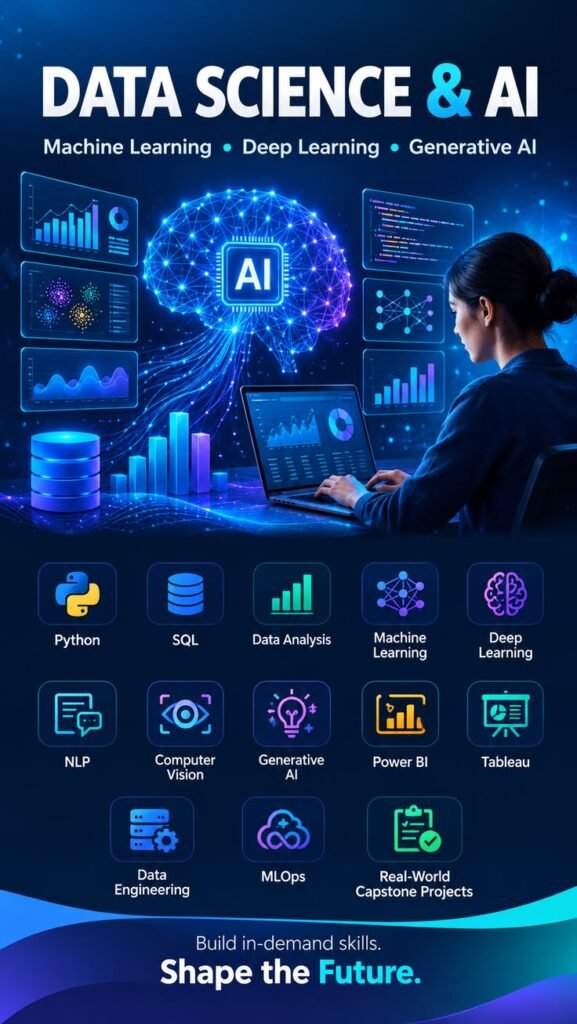
Looking for a practical and career-focused ai and data science course bangalore? Fast Learning Technologies offers a structured AI and Data Science training program designed for students, fresh graduates, working professionals, career switchers, and technology learners who want to build strong skills in Python, data analysis, machine learning, artificial intelligence, data visualization, statistics, model building, and real-time projects.
Bangalore is one of India’s strongest technology hubs, with IT companies, AI startups, analytics firms, product-based companies, fintech businesses, healthcare technology companies, e-commerce brands, SaaS companies, and global innovation centers. These companies use artificial intelligence and data science to improve decision-making, automate processes, predict outcomes, personalize customer experiences, and build intelligent digital products.
At Fast Learning Technologies, our AI and Data Science course in Bangalore is designed to make advanced topics simple, practical, and career-focused. Students learn step by step, starting from Python and data handling, then moving into statistics, machine learning, AI concepts, model evaluation, real-time datasets, and project implementation.
Whether you are a beginner or already have basic technical knowledge, this course helps you build a strong foundation for AI, data science, analytics, and machine learning careers.
What Makes Fast Learning Technologies a Trusted Choice?
Fast Learning Technologies focuses on practical learning, clear explanation, and career-oriented training. Many learners want to enter AI and data science but feel confused about where to start. Some students think AI is too difficult. Some worry about mathematics. Some working professionals want to upgrade their skills but do not know which tools and concepts are required.
Our training solves this confusion with a structured learning path. We start with fundamentals and gradually move toward practical AI and data science workflows. Students learn how to work with data, clean datasets, analyze patterns, create visual reports, build basic machine learning models, understand AI applications, and explain project results.
A good AI and Data Science professional should not only know tools. They should understand data, ask the right questions, select the right approach, test model performance, and explain insights clearly. Fast Learning Technologies trains students with this complete professional mindset.
What Makes Our AI and Data Science Course Different?
Our course focuses on:
- Beginner-friendly AI and data science concepts
- Python programming for data and AI tasks
- Data analysis and visualization practice
- Statistics and probability explained simply
- Machine learning algorithms and model building
- Artificial intelligence concepts and applications
- Real-time datasets and case studies
- Practical project-based training
- Resume and interview preparation
- Bangalore-focused career guidance
Our Alumni's Are Placed At


Course Curriculum
Machine Learning Module
A. Supervised Learning
Supervised Learning is a machine learning technique where the model is trained using labelled data.
1. Linear Regression
Linear Regression is used to predict continuous numerical values.
Topics Covered:
- Linear Equation
- Slope
- Intercept
- R-Square Value
2. Logistic Regression
Logistic Regression is used for classification problems where the output is usually binary, such as yes/no or success/failure.
Topics Covered:
- Odds Ratio
- Probability of Success
- Probability of Failure
- Bias Variance Tradeoff
- ROC Curve
Hands-on Exercise
Students will review the main ways to approach data modelling problems using simple and well-defined machine learning techniques. They will learn how to model past data using mathematical functions and predict new outputs based on trained models.
B. Unsupervised Learning
Duration: 4 Hours
Unsupervised Learning is used when the data does not have labelled outputs. The model identifies hidden patterns and groups in the data.
Topics Covered:
- K-Means Clustering
- K-Means++
- Hierarchical Clustering
C. Support Vector Machine
Duration: 2 Hours
Support Vector Machine is a powerful supervised learning algorithm used for classification and regression tasks.
Topics Covered:
- Support Vectors
- Hyperplanes
- 2-D Case
- Linear Hyperplane
D. SVM Kernel
Duration: 2 Hours
SVM Kernel helps transform data into higher dimensions to make classification easier.
Topics Covered:
- Linear Kernel
- Radial Kernel
- Polynomial Kernel
E. Other Machine Learning Algorithms
Duration: 10 Hours
Topics Covered:
- K-Nearest Neighbour
- Naïve Bayes Classifier
- Decision Tree – CART
- Decision Tree – C5.0
- Random Forest
Hands-on Exercise
Students will work on practical machine learning models and understand how different algorithms solve real-world problems. They will also explore regression techniques, clustering methods, and mathematical tools used for approximating unknown values.
Artificial Intelligence Module
Module 1: AI Introduction
Duration: 9 Hours
Artificial Intelligence focuses on creating intelligent systems that can think, learn, and make decisions.
Topics Covered:
- Perceptron
- Multi-Layer Perceptron
- Markov Decision Process
- Logical Agent
- First Order Logic
- AI Applications
Deep Learning Module
Module 1: Deep Learning Algorithms
Duration: 10 Hours
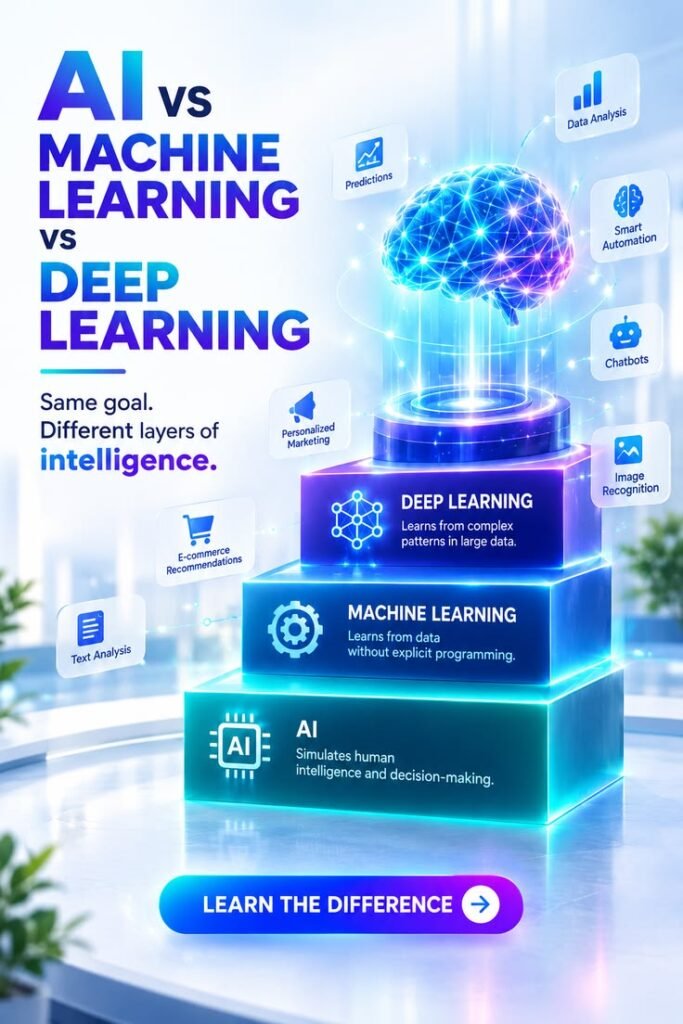
Deep Learning is a subset of Machine Learning that uses neural networks to solve complex problems such as image recognition, speech recognition, and natural language processing.
Topics Covered:
- CNN – Convolutional Neural Network
- RNN – Recurrent Neural Network
- ANN – Artificial Neural Network
Hands-on Exercise
Students will learn how to implement their first neural network and understand the foundation of deep learning architectures. This module will help students apply previously learned concepts to advanced neural network models.
Natural Language Processing Module
A. Introduction to NLP
Duration: 5 Hours
Natural Language Processing helps machines understand, process, and analyze human language.
Topics Covered:
- Text Pre-processing
- Noise Removal
- Lexicon Normalization
- Lemmatization
- Stemming
- Object Standardization
B. Text to Features / Feature Engineering
Duration: 5 Hours
Feature Engineering converts raw text into structured data that can be used by machine learning models.
Topics Covered:
- Syntactical Parsing
- Dependency Grammar
- Part of Speech Tagging
- Entity Parsing
- Named Entity Recognition
- Topic Modelling
- N-Grams
- TF-IDF
- Frequency / Density Features
- Word Embeddings
C. Tasks of NLP
Duration: 2 Hours
Topics Covered:
- Text Classification
- Text Matching
- Levenshtein Distance
- Phonetic Matching
- Flexible String Matching
Hands-on Exercise
Students will learn how to create customized NLP models. They will work on text-based problems and understand how machine learning models can process and classify natural language data.
Final Projects
Project 1: Board Game Review Prediction
Students will perform Linear Regression analysis to predict average reviews for board games.
Project 2: Credit Card Fraud Detection
Students will focus on Anomaly Detection using probability densities to detect credit card fraud.
Project 3: Stock Market Clustering
Students will use K-Means Clustering to find related companies by analyzing correlations among stock market movements over a given time span.
Project 4: Getting Started with Natural Language Processing
Students will learn basic NLP methodology, including:
- Tokenizing words and sentences
- Part of speech identification
- Tagging
- Phrase analysis
Project 5: Object Recognition Using Deep Learning
Students will use the CIFAR-10 object recognition dataset as a benchmark to implement a deep neural network model for object recognition.
Project 6: Image Super Resolution with SRCNN
Students will learn how to implement and use the TensorFlow version of the Super Resolution Convolutional Neural Network, also known as SRCNN, to improve image quality.
Project 7: Natural Language Processing – Text Classification
Students will solve a text classification task using multiple classification algorithms and advanced NLP techniques.
Project 8: K-Means Clustering for Image Analysis
Students will use K-Means Clustering as an unsupervised learning method to analyze and classify 28 x 28 pixel images from the MNIST dataset.
Project 9: Data Compression & Visualization Using PCA
Students will learn how to compress the Iris dataset into a 2D feature set and visualize it through a normal X-Y plot using K-Means Clustering.
Hands-On Projects to Strengthen Your Portfolio
AI-Powered Customer Sentiment Analysis and Recommendation System (Domain: Retail & E-Commerce)
Tools Used: Python, Machine Learning, Power BI, SQL, Excel Build an intelligent system to analyze customer reviews, social media feedback, and purchasing behavior using NLP techniques. Predict customer satisfaction and recommend personalized products through interactive dashboards.
Software Bug Prediction and Defect Analysis Platform (Domain: Software Testing)
Tools Used: Python, Machine Learning, Power BI, SQL, Excel Analyze software testing data, defect logs, and application performance to predict high-risk modules, identify bug patterns, and improve software quality management.
Cloud Infrastructure Monitoring and Resource Optimization System (Domain: Cloud Computing & DevOps)
Tools Used: Python, Power BI, SQL, Excel, AWS/Azure Monitor cloud server performance, CPU usage, storage utilization, and network traffic to optimize infrastructure costs and improve system reliability.
Cybersecurity Threat Detection and Network Traffic Analysis (Domain: Cybersecurity)
Tools Used: Python, Machine Learning, Power BI, SQL, Excel Analyze network logs, suspicious activities, malware patterns, and unauthorized access attempts to detect cyber threats and improve security monitoring systems.
AI-Powered IT Helpdesk Ticket Classification System (Domain: IT Support)
Tools Used: Python, NLP, Power BI, SQL, Excel Develop an automated ticket classification system that categorizes IT support requests, predicts priority levels, and improves response efficiency using Natural Language Processing.
Employee Productivity and System Usage Analytics Platform (Domain: IT Operations)
Tools Used: Python, Power BI, SQL, Excel Analyze employee login activity, project tracking, system utilization, and work performance to improve operational efficiency in IT organizations.
Intelligent Server Performance and Downtime Prediction System (Domain: System Administration)
Tools Used: Python, Machine Learning, Power BI, SQL, Excel Monitor server logs, CPU utilization, memory usage, and downtime history to predict failures and improve infrastructure availability.
AI-Based Code Recommendation and Developer Productivity Analysis (Domain: Software Development)
Tools Used: Python, Machine Learning, Power BI, SQL, Excel Analyze coding patterns, GitHub commits, project timelines, and bug fixes to recommend optimized coding practices and improve developer productivity.
DevOps CI/CD Pipeline Performance Analytics System (Domain: DevOps Engineering)
Tools Used: Python, Power BI, SQL, Excel, Jenkins/Git Track deployment frequency, build failures, testing results, and release cycles to optimize CI/CD pipeline efficiency and software delivery performance.
IT Asset Management and Hardware Failure Prediction System (Domain: IT Infrastructure)
Tools Used: Python, Machine Learning, Power BI, SQL, Excel Analyze hardware usage, maintenance records, device performance, and asset lifecycle data to predict failures and optimize IT asset management.
Trainer profile

Kiran Babu
(10 years) – Kiran Babu brings a decade of hands-on experience in data analytics and machine learning.
Praveen
(8 years) – Praveen has 8 years of experience in data science and AI applications.
Arun
(13 years) – Arun is a seasoned data science professional with 13 years of experience in big data, AI, and advanced analytics.
Ankit
(10 years) – Ankit has 10 years of experience in machine learning and data engineering.
Dibiya Jyothi
(11 years) – Dibiya Jyothi brings 11 years of expertise in AI, deep learning, and data modeling.
Course batch schedule
| Date | Course Name | Batch Type | October Timings | November Timings |
|---|---|---|---|---|
| 02 Oct | Python | New Batch | 8 AM - 9 AM | 8 AM - 9 AM |
| 02 Oct | SQL | New Batch | 6 PM - 7 PM | 6 PM - 7 PM |
| 03 Oct | Excel | New Batch | 9 AM - 10 AM | 9 AM - 10 AM |
| 03 Oct | Power BI | New Batch | 2 PM - 3 PM | 2 PM - 3 PM |
| 04 Oct | AWS | New Batch | 5 PM - 6 PM | 5 PM - 6 PM |
| 04 Oct | Frontend | New Batch | 10 AM - 11 AM | 10 AM - 11 AM |
| 07 Oct | Linux | New Batch | 4 PM - 5 PM | 4 PM - 5 PM |
| 08 Oct | Data Science | New Batch | 8 AM - 9 AM | 8 AM - 9 AM |
| 08 Oct | Machine Learning | New Batch | 5 PM - 6 PM | 5 PM - 6 PM |
| 09 Oct | Java Full Stack | New Batch | 9 AM - 11 AM | 9 AM - 11 AM |
| 10 Oct | Web Development | New Batch | 12 PM - 2 PM | 12 PM - 2 PM |
| 11 Oct | Digital Marketing | New Batch | 3 PM - 4 PM | 3 PM - 4 PM |
| October | November | |||
| 16 Oct | Graphic Design | New Batch | 6 PM - 7 PM | 6 PM - 7 PM |
| 17 Oct | Cloud Computing (Azure) | New Batch | 9 AM - 10 AM | 9 AM - 10 AM |
| 18 Oct | Cyber Security | New Batch | 1 PM - 2 PM | 1 PM - 2 PM |
| 21 Oct | React JS | New Batch | 4 PM - 5 PM | 4 PM - 5 PM |
| 22 Oct | UI/UX Design | New Batch | 7 PM - 8 PM | 7 PM - 8 PM |
| 23 Oct | Python with Data Analysis | New Batch | 10 AM - 11 AM | 10 AM - 11 AM |
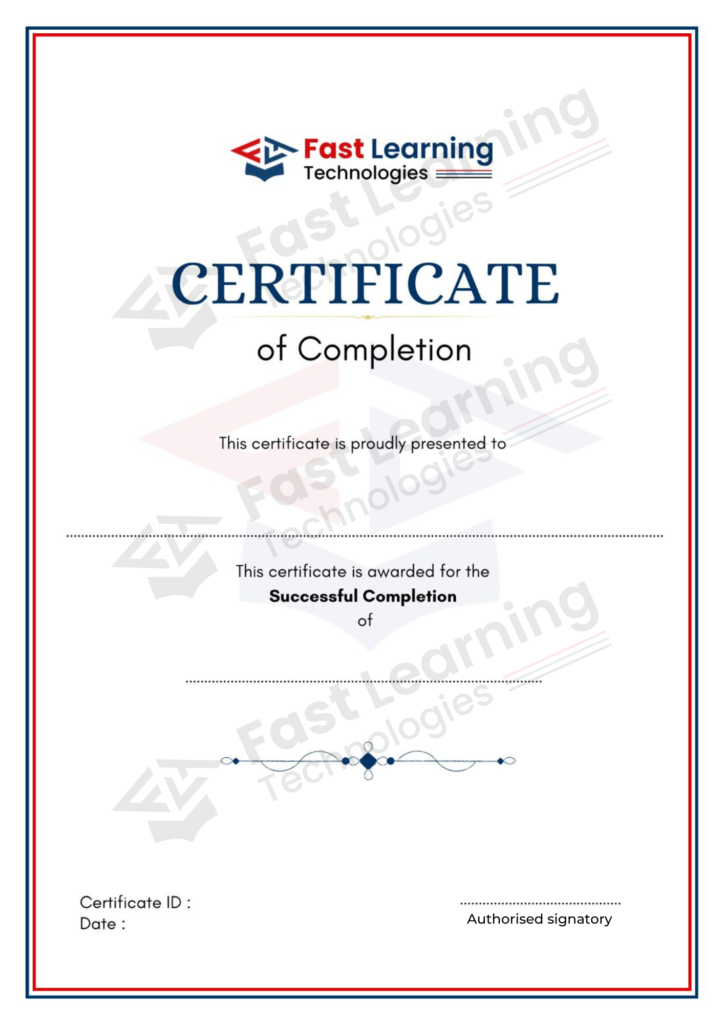
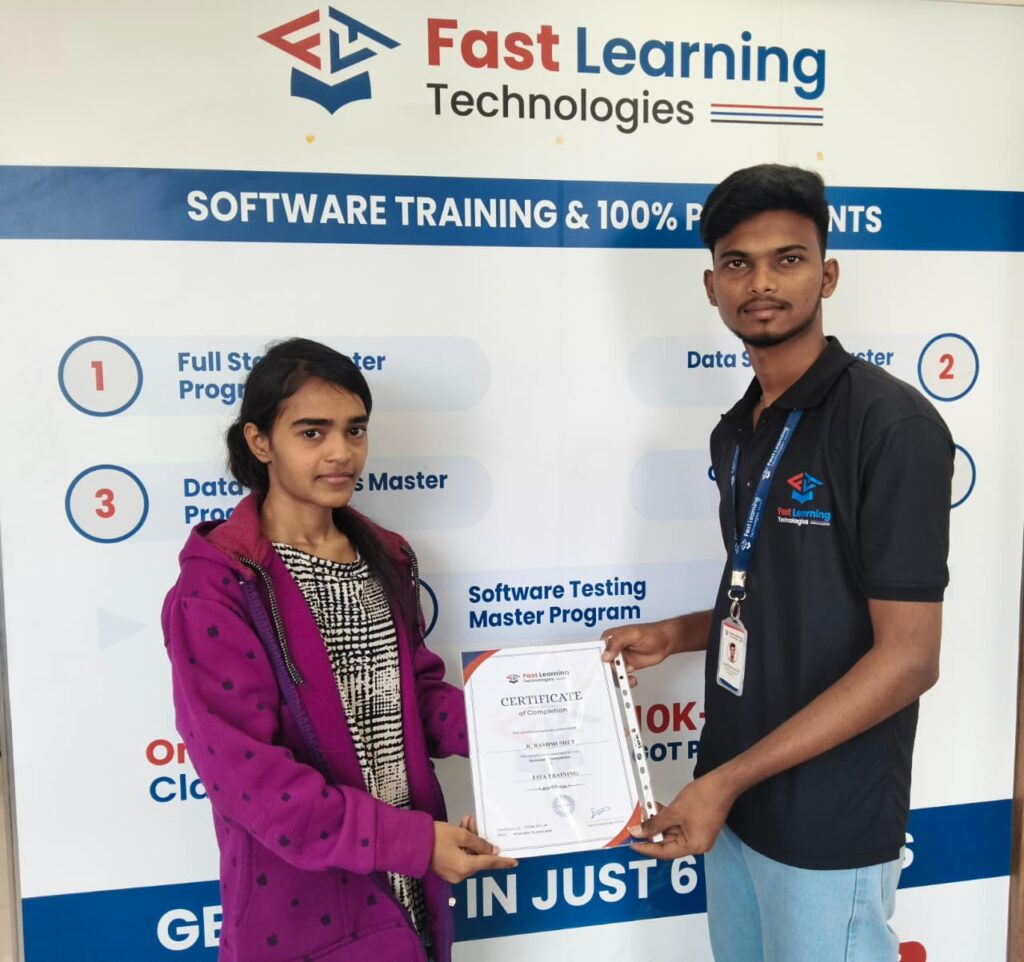
Get Certified & Prove Your Industry Readiness
All major global multinational corporations accept our certification. We provide after completion of the theoretical and practical sessions to fresher’s as well as corporate trainees, by earning this certification, which is provided at the conclusion of the course.
You can increase the importance of your profile during interviews and gain access to a wide range of professional opportunities by combining this certificate with your CV.
The certification is only given upon the successful completion of our training and project-based projects with a practical component.
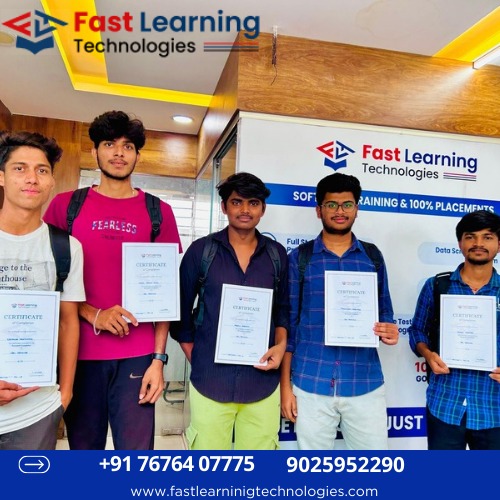
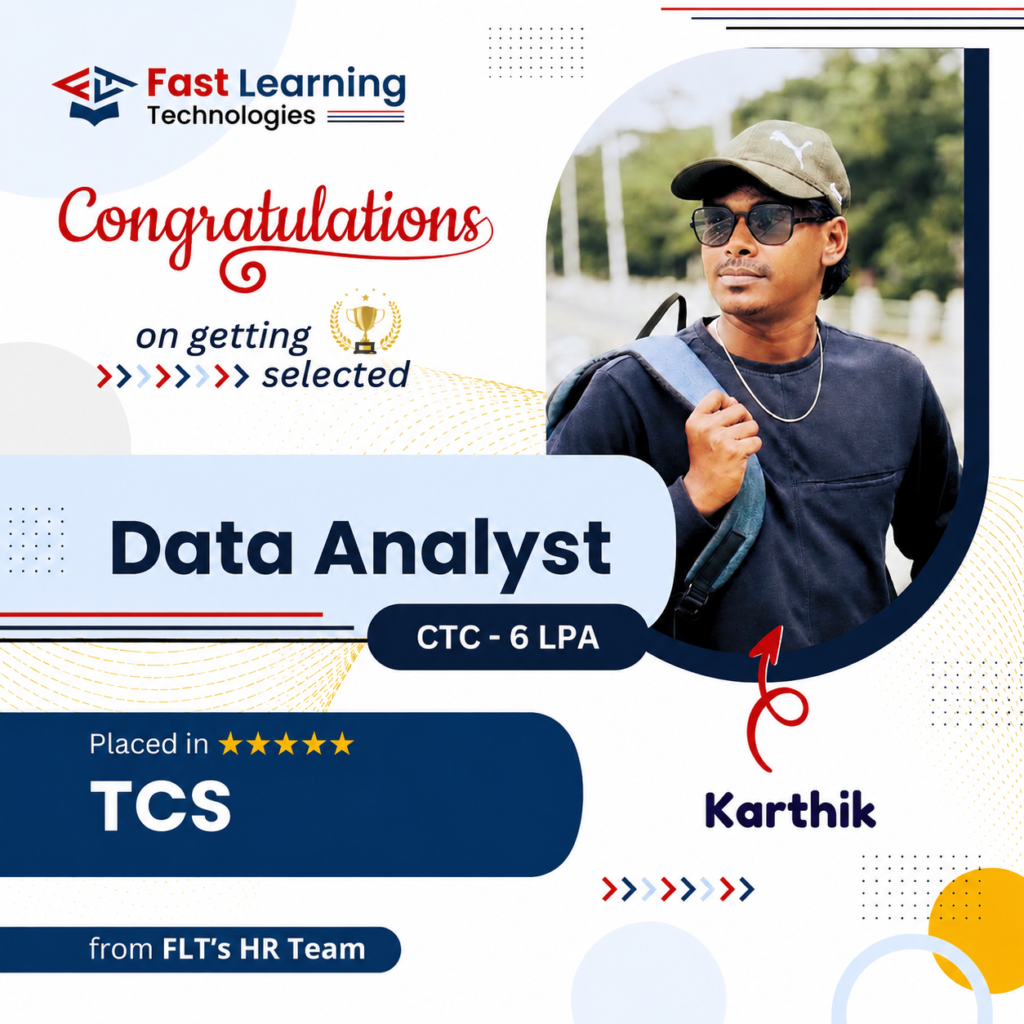
200+
Placed
Rs. 4.5 LPA
Average Salary
50+
Companies
100%
Guaranteed interviews
Students Placements



EXCELLENT Based on 140 reviews
 Posted on Google
 Santhosh bavanI was looking for a training institute that provides both course training and internship opportunities, and Fast Learning Technologies was the right choice. The trainers are knowledgeable and supportive. The hands-on training, real-time projects, internship experience, and placement assistance helped me improve my skills and confidence. Highly recommended for anyone looking to start a career in IT.Posted on Google
 Ranjith VeluI was searching for a Data Analytics course and found Fast Learning Technologies. One of the best institutes for learning with hands-on training. They also provide internship opportunities. I completed my Data Analytics internship here and gained practical experience through real-time projects. The trainers are supportive and the learning environment is excellent. Highly recommended for anyone looking to start a career in Data Analytics.Posted on Google
 karthikeyan karthikeyanOne of the best institutes for learning Python with hands-on training. They also provide Python internship opportunities, which helped me gain practical experience and improve my skills. The trainers are supportive, and the training includes real-time practice. Highly recommended for students and job seekers looking to build a career in Python.Posted on Google
 muni rajCloud and DevOps course is very informative and practical. Trainers provide hands-on training with real-time scenarios. The HR team support is good for placements. Best IT training in Nagawara.Posted on Google
 Vijay BabuCurrently learning Data Science, the trainers are knowledgeable, approachable. The class rooms are well arranged with enough chairs and boards also equipped with Big monitors for explanation. The management and staff are professional, kind and approachable also knowledge about the courses. The demo class with Kiran is honest with career councelling and opportunities also structure of the course. My overall experience far is amazing.Posted on Google
 Krishna PriyaI joined Data Analytics training near Manyata Tech Park after a long career gap. Kiran sir motivated me and provided excellent hands on training. Real time projects helped me rebuild my confidence. Best data analytics training in bangalore manyata tech park.Posted on Google
 Abdul KJoined fot Data anlyst course. Demo classes were provided. The trainers are knowledgeable, The class rooms are equipped with advanced technology, Air conditioning (even if students visit for practice purpose). Staff is professional and well knowledgeable about courses and most importantly they are patient enough to listen and understand to us and well approachable.Posted on Google
 Krishna VeniHR team support is very good, they guided me during placement
Data Science Course Fee and Duration
Classroom Sessions
38,000/- Offer price
- Fees payable in up to 3 installments
- 0% Interest EMI – Pay in Easy Installments (though education financing partners)
- Cost-effective courses with high ROI, making it worth every penny you invest.
Students Review
Fast Learning Technologies offers the best Data Analytics training in Bangalore. I enrolled in their program to enhance my skills in this field, and I was able to learn everything in depth. I would like to thank the entire team at Fast Learning Technologies for their support. I highly recommend this training to my friends. Thank you.

Surya
My Honest Review. Joined Fast Learning Technologies with Zero Knowledge on SQL but after completing the course i can confidently say that I gained lot of knowledge on SQL. Trainers here are best in the industry. I will never have a second thought to refer any of my friends to this institute. Keep doing good

Saravana Natraj
This is a very good institute with excellent facilities, and I am confident that everyone will find a job after completing their training. The practical classes are beneficial, and the instructor covered all the material with impressive presentation skills. I highly recommend this institute, especially for those not in the IT field.

Lalith Kumar
Frequently Asked Questions (FAQ)
Fast Learning Technologies offers a practical AI and Data Science course in Bangalore for students, freshers, and working professionals. The course covers Python, data analysis, statistics, machine learning, AI concepts, real-time projects, resume guidance, and interview preparation.
Yes. Beginners can join this course. The training starts with Python basics and gradually moves into data science, statistics, machine learning, AI concepts, and project practice.
No advanced coding knowledge is required before joining. Basic computer knowledge is enough to start. Python programming is taught step by step during the course.
After completing the course and gaining enough practice, you can apply for roles such as Data Analyst, Junior Data Scientist, AI Associate, Machine Learning Trainee, BI Analyst, Python Data Analyst, and Analytics Associate.
Yes. Bangalore has a strong IT, startup, AI, analytics, and product company ecosystem. Many companies use AI and data science for automation, prediction, reporting, customer analysis, and intelligent product development.