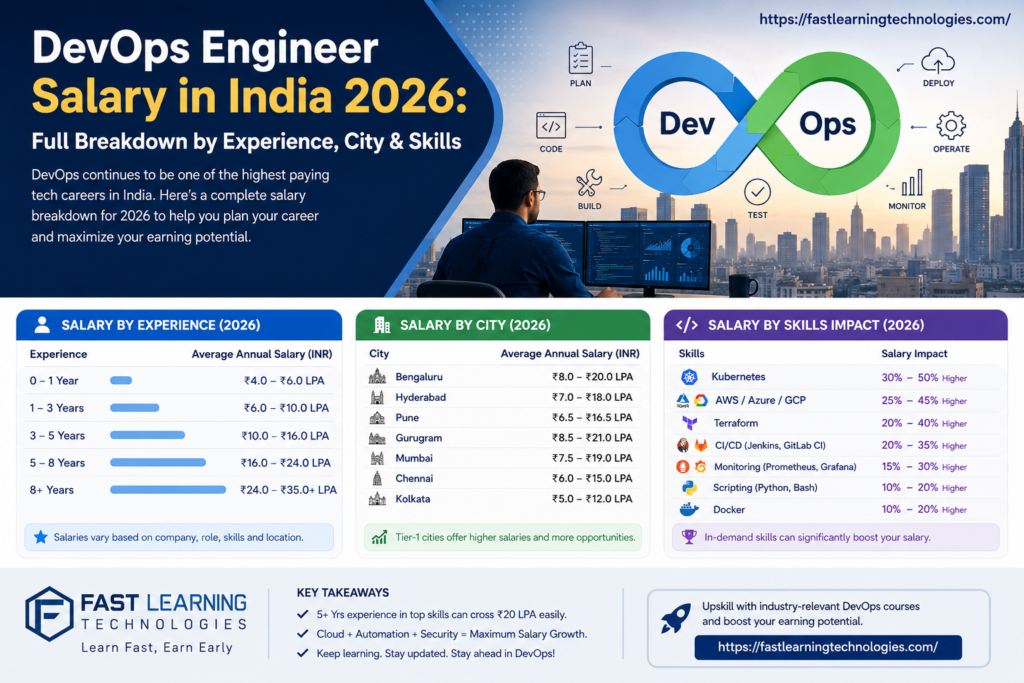
DevOps Engineer Salary in India 2026: Full Breakdown by Experience, City & Skills
DevOps Engineer Salary India 2026 is one of the most searched technology career topics as companies continue investing heavily in cloud infrastructure, automation, Kubernetes, and platform engineering. The average DevOps engineer salary in India ranges from ₹7–9 LPA across all experience levels, but actual earnings vary significantly based on experience, location, company type, certifications, and technical expertise. This guide provides a complete breakdown of DevOps Engineer Salary India 2026 by experience, city, skills, and industry trends. The average DevOps engineer salary in India in 2026 is ₹7–9 LPA across all experience levels, but that single figure is nearly meaningless. Freshers earn ₹3.5–6 LPA; senior engineers earn ₹18–35 LPA; and principal engineers at product companies clear ₹60 LPA+. This guide breaks down DevOps engineer salary in India 2026 by experience, city, company type, and skills — so you know exactly where you stand and what it takes to earn more.
Why Salary Figures Vary So Much
Search “DevOps engineer salary India” and you’ll see figures ranging from ₹7 LPA to ₹26 LPA — sometimes on the same results page. The reason is methodology, not error.
Source | Reported Average | Why |
Glassdoor (June 2026) | ₹7 LPA | Self-reported, all seniority levels, skews entry-level |
Scaler / SwitchToDevOps | ₹9 LPA | Editorial estimates, mid-career focus |
AmbitionBox / 6figr | ₹19–26 LPA | Skews toward experienced professionals who voluntarily share |
SalaryExpert | ₹20.9 LPA | Employer survey data, weighted toward larger companies |
Use Glassdoor to benchmark entry-level offers. Use AmbitionBox or SalaryExpert once you have 5+ years of experience. Neither source is wrong — they’re measuring different populations.
DevOps Engineer Salary by Experience Level
Fresher (0–2 years)
Range: ₹3.5–6 LPA
Entry-level DevOps roles in service-based companies (TCS, Infosys, Wipro) typically start at ₹3.5–4.5 LPA. Product-based companies and funded startups pay ₹5–7 LPA for the same profile, provided you bring hands-on project experience with CI/CD pipelines or Kubernetes to the table.
Freshers with an AWS Cloud Practitioner or Azure Fundamentals certification can negotiate 20–30% above base offers (SwitchToDevOps, 2026).
Junior (2–4 years)
Range: ₹6–12 LPA
At this stage you’re expected to own pipelines end-to-end, write infrastructure-as-code scripts, and have meaningful cloud exposure. Engineers who earn at the top of this band typically hold an associate-level cloud certification and can demonstrate production incident resolution experience.
Mid-level (4–7 years)
Range: ₹12–20 LPA
The largest salary jump in a DevOps career typically happens between junior and mid-level. At this stage, the gap between engineers widens significantly based on tech stack depth — those specialising in Kubernetes, Terraform, and multi-cloud architecture command the upper end. Mid-level is also the prime window for a job switch: a lateral move at this stage commonly yields a 30–50% salary increase.
Senior (7–10 years)
Range: ₹18–35 LPA
Senior DevOps engineers lead platform and infrastructure decisions, mentor teams, and are directly accountable for reliability and release velocity. Companies pay a significant premium here because replacing a senior DevOps engineer who knows the production environment is expensive.
Lead / Principal (10+ years)
Range: ₹30–60 LPA+
Principal and Staff DevOps engineers at MNCs and product companies routinely earn in this band. FAANG and Big Tech outliers (Google, Microsoft, Amazon India) go well above, with total compensation including ESOPs reaching ₹80–120 LPA for the right profile (AmbitionBox, 2026).
Summary table:
Experience | Typical Range | Key Driver |
0–2 yrs (Fresher) | ₹3.5–6 LPA | Company type + certifications |
2–4 yrs (Junior) | ₹6–12 LPA | Cloud exposure + pipeline ownership |
4–7 yrs (Mid-level) | ₹12–20 LPA | Stack depth + job switch leverage |
7–10 yrs (Senior) | ₹18–35 LPA | System ownership + leadership |
10+ yrs (Lead/Principal) | ₹30–60 LPA+ | Scope, org impact, ESOP |
DevOps Salary by City
Geography still matters, though remote work has started to compress the gap at senior levels.
City | Premium vs National Average | Notes |
Bangalore | +20–25% | Highest density of product and Big Tech offices |
Hyderabad | +15–20% | Fast-growing; strong MNC presence |
Pune | +10–15% | Emerging tech hub; lower cost of living |
Chennai | +5–10% | Solid IT base; competitive for mid-level roles |
Mumbai | +10–15% | Financial-sector DevOps (fintech, BFSI) pays well |
Gurgaon/Noida (NCR) | +5–10% | Strong startup ecosystem |
Tier-2 cities | –10–20% | Catching up, but gap remains |
At the senior and lead level, remote-first companies increasingly pay Bangalore-equivalent salaries regardless of location — a trend worth factoring into your job search strategy.
DevOps Salary by Company Type
Where you work matters as much as how long you’ve worked.
Company Type | Fresher | Mid-level | Senior |
FAANG / Big Tech | ₹12–20 LPA | ₹25–45 LPA | ₹45–80 LPA+ |
MNC (IBM, Cisco, SAP) | ₹6–10 LPA | ₹15–25 LPA | ₹28–40 LPA |
Mid-size product startup | ₹5–8 LPA | ₹12–20 LPA | ₹20–35 LPA |
Service-based IT | ₹3.5–5 LPA | ₹7–12 LPA | ₹14–20 LPA |
Service-based companies offer stability and training; product companies offer speed, autonomy, and significantly better pay. Most engineers who want to maximise earnings target a service-based role for the first 2 years to build fundamentals, then switch to a product company or startup.
Skills That Command a Pay Premium
Not all DevOps skills pay equally. Based on 2026 job posting data:
Skill / Tool | Pay Premium |
AWS / Azure / GCP certifications (professional level) | +25–35% |
Kubernetes (CKA certified) | +20–30% |
Terraform / Pulumi (IaC) | +15–20% |
CI/CD (Jenkins, GitHub Actions, ArgoCD) | +10–15% |
Ansible / Chef / Puppet | +8–12% |
Platform Engineering / Internal Developer Platforms | +20–25% (emerging) |
AIOps / ML pipeline infrastructure | +25–30% (high demand, low supply) |
The biggest multiplier in 2026 is holding a professional-level cloud certification (AWS Solutions Architect Professional, GCP Professional Cloud Architect, or Azure Solutions Expert) combined with hands-on Kubernetes experience. Engineers with both consistently negotiate into the upper third of their experience band.
How to Negotiate a Higher DevOps Salary
Time your moves. In DevOps, an 18–24 month job switch is well within industry norms. Staying loyal to a single employer for 5+ years without promotion often means earning 20–30% less than market rate by year 4.
Certify before you negotiate, not after. A professional-level cloud cert is a concrete justification for a higher offer — use it as leverage in the same job cycle you earn it, not later.
Benchmark with multiple sources. Walk into negotiations with data from at least two salary platforms. Glassdoor for the floor, AmbitionBox for the ceiling — both are credible and interviewers know them.
What not to negotiate away. Salary is one number. Remote flexibility, an annual learning budget (₹50,000–₹1,00,000 is standard at good companies), and stock options at startups can each add significant real value. Don’t concede these for a marginally higher fixed component.
Is DevOps Still Worth Pursuing in 2026?
Yes — with a nuance. The DevOps title is evolving into Platform Engineering and Site Reliability Engineering (SRE) at senior levels, but the underlying demand — people who can build, automate, and scale infrastructure — is not going away. If anything, the shift toward AI-driven infrastructure and ML pipelines has created a new specialisation (MLOps / AIOps) that commands salaries at the top of the DevOps pay scale.
Hiring demand for DevOps professionals in India remained strong in Q1–Q2 2026, with Bangalore, Hyderabad, and remote-first roles accounting for the majority of open positions. The career trajectory is sound; the label on the job title is what’s changing.
Quick Summary
- Fresher: ₹3.5–6 LPA (service-based) to ₹5–7 LPA (product)
- Mid-level: ₹12–20 LPA — the highest-leverage career stage for salary growth
- Senior: ₹18–35 LPA; Big Tech goes to ₹45 LPA+
- Bangalore and Hyderabad pay 15–25% above the national average
- Cloud certifications + Kubernetes are the two highest-ROI salary boosters in 2026
- Don’t benchmark with a single source — cross-reference Glassdoor, AmbitionBox, and SalaryExpert for a realistic range