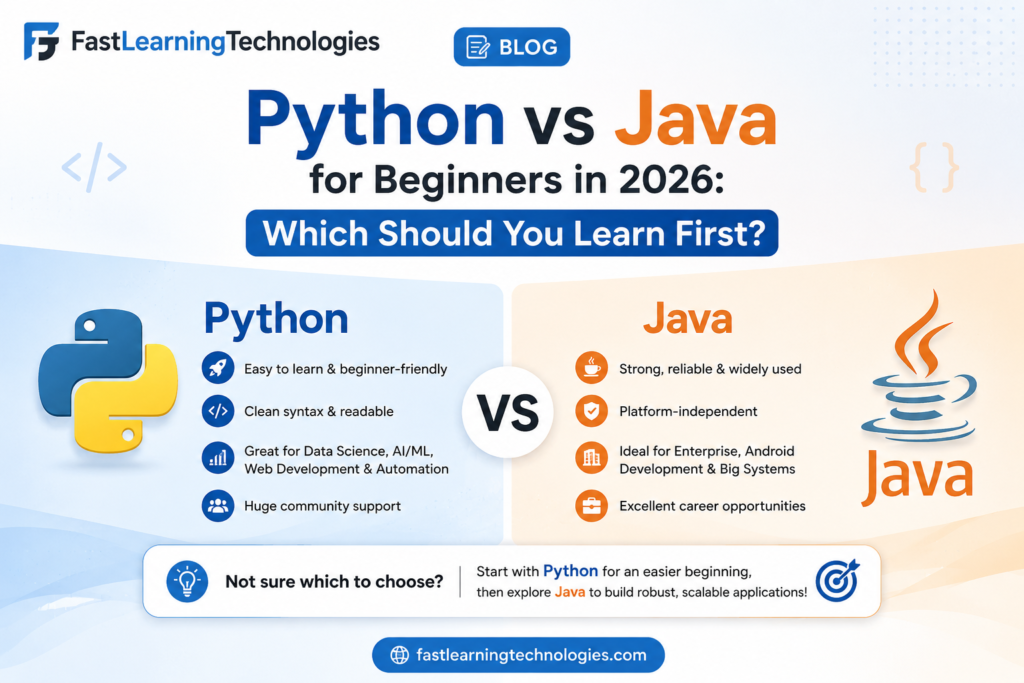
Python vs Java for Beginners in 2026: Which Should You Learn First?
Choosing between Python and Java can be confusing when you are starting your programming career. Many students search for python vs java for beginners because both languages are popular, job-focused, and useful in different career paths. In this guide, we will compare Python and Java in simple terms so you can decide which language to learn first in 2026.
This article covers learning difficulty, career scope, salary expectations, tools, use cases, and the best learning path for beginners.
Python vs Java for Beginners: Quick Comparison
Python is usually easier for beginners because its syntax is simple and close to English. You can write a basic Python program with fewer lines of code. This makes it suitable for students who are completely new to programming.
Java takes more time in the beginning because it uses strict syntax, classes, objects, and more structure. However, this structure helps learners understand object-oriented programming clearly. Java is widely used in enterprise applications, Android development, backend systems, and large-scale software projects.
Here is a simple comparison:
| Factor | Python | Java |
|---|---|---|
| Beginner difficulty | Easier | Moderate |
| Syntax | Simple and clean | More structured |
| Best for | Data science, AI, automation, scripting, web development | Backend development, Android, enterprise software, full stack |
| Coding speed | Faster for small programs | Better for structured applications |
| Job market | Strong in AI, data, automation, web | Strong in backend, banking, IT services, enterprise |
| Best first choice | Absolute beginners | Students serious about software engineering |
For most beginners in 2026, Python is the better first language. It helps you understand programming logic faster. After Python, learning Java becomes easier because you already understand variables, loops, functions, and problem-solving.
Why Python Is Easier for Beginners
Python is often recommended as the first programming language because it reduces the fear of coding. You do not need to write too much setup code to create your first program. The syntax is short, readable, and beginner-friendly.
For example, printing a message in Python is simple:
print("Hello World")
This helps beginners focus on logic instead of complicated syntax. Python is also useful in many career paths. You can use it for web development, data analytics, machine learning, artificial intelligence, automation, testing, and basic software development.
Python also has a large number of libraries and tools. Beginners can explore tools like:
| Area | Python Tools |
|---|---|
| Web development | Django, Flask |
| Data analysis | Pandas, NumPy |
| AI and ML | TensorFlow, Scikit-learn |
| Automation | Selenium, BeautifulSoup |
| App logic | FastAPI |
Another advantage is project building. Beginners can quickly create small projects such as calculators, file automation scripts, weather apps, data dashboards, and basic AI tools. These projects help build confidence and portfolio value.
Python is a strong choice if your goal is to enter fields like AI, data science, automation, analytics, or backend development.
Why Java Is Still Important in 2026
Java may not feel as easy as Python in the first week, but it remains one of the strongest programming languages for serious software development. Many large companies use Java for banking systems, enterprise applications, cloud platforms, backend services, and Android applications.
Java teaches strong programming discipline. You learn classes, objects, methods, data types, error handling, and structured coding from the beginning. This is useful for students who want to become backend developers, full stack developers, Android developers, or software engineers.
Java is also popular in IT service companies and enterprise environments. Many companies prefer Java for large applications because it is stable, scalable, and secure. Frameworks like Spring Boot make Java useful for modern backend development.
Important Java tools include:
| Area | Java Tools |
|---|---|
| Backend development | Spring Boot |
| Build tools | Maven, Gradle |
| Database work | JDBC, Hibernate |
| Testing | JUnit |
| Development | IntelliJ IDEA, Eclipse |
Java is a good first language if you want to build a strong foundation in object-oriented programming. However, if you are nervous about coding, Python may be a smoother starting point.
Python vs Java Salary Scope in India
Both Python and Java can lead to good career opportunities. Salary depends on your location, project skills, communication, interview performance, and practical experience.
For beginners in India, Python developer salaries often start around ₹3 LPA to ₹6 LPA. Candidates with strong projects in data analytics, automation, AI tools, or backend development may get better opportunities.
Java freshers often see salary ranges around ₹3.5 LPA to ₹6 LPA in many entry-level roles. Java full stack, Spring Boot, and backend development roles can offer higher packages once the candidate gains real project experience.
| Role | Beginner Salary Estimate |
|---|---|
| Python Developer | ₹3 LPA – ₹6 LPA |
| Java Developer | ₹3.5 LPA – ₹6 LPA |
| Backend Developer | ₹4 LPA – ₹8 LPA |
| Full Stack Developer | ₹4 LPA – ₹9 LPA |
| Data Analyst with Python | ₹3 LPA – ₹7 LPA |
Salary should not be your only deciding factor. A beginner with strong projects, GitHub work, interview preparation, and practical training can perform better than someone who only completes theory.
If you want faster entry into coding, start with Python. If you want backend and enterprise software roles, Java is also a powerful option.
Which Should You Learn First in 2026?
The answer depends on your goal.
Choose Python first if you are a complete beginner. It is easier to understand and helps you learn programming logic faster. Python is also useful for AI, data analytics, automation, scripting, and beginner-friendly backend development.
Choose Java first if your goal is software engineering, backend development, enterprise applications, or Android development. Java takes more effort in the beginning, but it builds strong coding discipline.
A practical learning path can look like this:
Start with Python basics.
Learn logic building and problem-solving.
Build 3 to 5 small projects.
Learn SQL and database basics.
Choose a career track: Python backend, data analytics, AI, Java backend, or full stack.
Learn Java later if you want enterprise or backend development.
For most beginners, the best path is not Python or Java forever. The better path is Python first, then Java if your career goal requires it.
Final Verdict: Python vs Java for Beginners
In 2026, Python is the better first language for most beginners because it is simple, practical, and used in many fast-growing fields. It helps students start coding quickly and build confidence.
Java is better for students who already know they want to work in backend development, Android development, or enterprise software. It has a steeper learning curve, but it gives a strong foundation for professional software development.
So, if you are asking “Python vs Java for beginners — which should I learn first?”, the answer is simple: start with Python if you are new to coding. Move to Java later if you want to become a full stack, backend, or enterprise software developer.
FAQ: Python vs Java for Beginners
1. Is Python easier than Java for beginners?
Yes. Python is easier because the syntax is simple and readable. Beginners can write programs with fewer lines of code.
2. Is Java hard for beginners?
Java is not impossible, but it takes more time because it has strict syntax and object-oriented concepts from the start.
3. Which has better job opportunities, Python or Java?
Both have strong job opportunities. Python is strong in AI, data, automation, and analytics. Java is strong in backend, full stack, Android, and enterprise software.
4. Which language should I learn first in 2026?
Most beginners should learn Python first. It helps you understand programming faster. Java can be learned later for backend and enterprise roles.
5. Can I learn Java after Python?
Yes. Learning Java after Python is a good path. Python teaches logic, and Java improves your understanding of structured programming.
6. Is Python good for freshers?
Yes. Python is good for freshers because it is used in many entry-level roles, including automation, data analytics, testing, and backend development.
7. Is Java good for freshers?
Yes. Java is good for freshers who want roles in software development, backend development, Android development, and IT services.
8. Which pays more, Python or Java?
Salary depends on skills, projects, company, and location. Python can pay well in AI and data roles. Java can pay well in backend and full stack roles.
9. What is the fee for this course at Fast Learning Technologies?
Course fees may vary based on batch type, duration, and training mode. Contact Fast Learning Technologies directly for the latest fee details.
10. Does Fast Learning Technologies provide placement support?
Yes. Fast Learning Technologies, Nagavara provides training with 100% placement support, practical learning, and interview preparation.