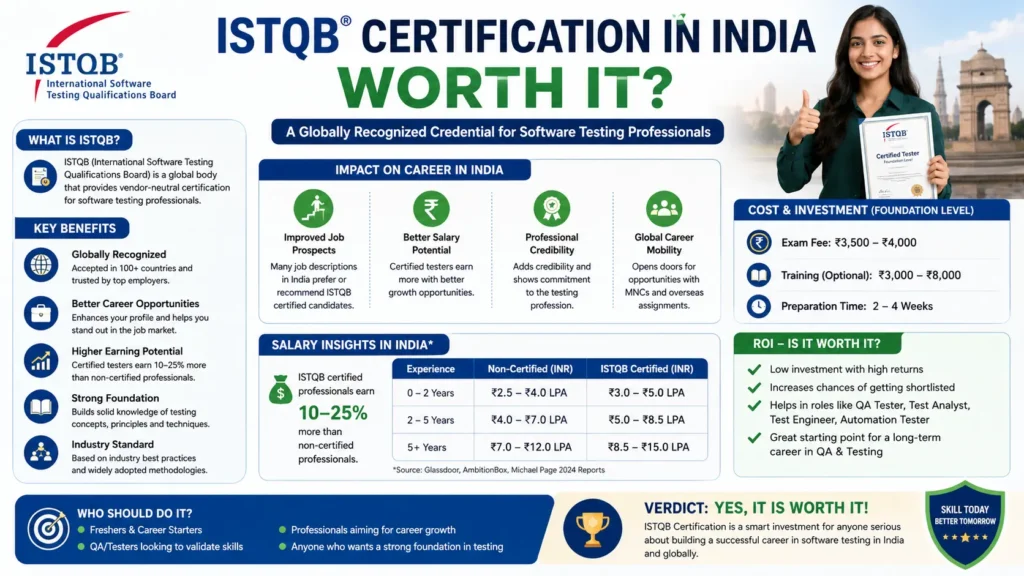
If you’re a fresh graduate exploring a career in software testing, chances are you’ve already run into the same question dozens of times on forums, LinkedIn posts, and WhatsApp groups: is ISTQB certification india worth it for freshers in India? The honest answer isn’t a flat yes or no — it depends on where you’re starting from, which companies you’re targeting, and what else is on your resume alongside the certificate. This guide breaks down what ISTQB actually is, what it does (and doesn’t) do for your career, what it costs in 2026, and how it fits into a realistic first-job plan for aspiring software testers in India.
What Is ISTQB Certification, Exactly?
ISTQB stands for the International Software Testing Qualifications Board, a non-profit body that sets a vendor-neutral standard for software testing terminology, processes, and techniques. It doesn’t teach you how to test software step by step — instead, it certifies that you understand a defined body of testing knowledge and can apply the correct terminology and concepts consistently.
The entry point for almost every fresher is the Certified Tester Foundation Level (CTFL), currently at version 4.0. It’s a multiple-choice exam covering fundamentals like the testing lifecycle, static and dynamic testing techniques, test management, and basic tool support. Once you clear Foundation Level, you become eligible for Advanced Level tracks in test management, technical testing, or test analysis.
In India, the exam isn’t administered by ISTQB directly. It runs through the Indian Testing Board (ITB), one of roughly 69 national member boards worldwide, alongside global providers. A certificate from any recognised board carries equal value internationally — there’s no hierarchy between boards, so a CTFL cleared through ITB is treated the same way in Bangalore, Berlin, or Dubai.
Why This Question Matters More in 2026
The testing job market has shifted. A few years ago, ISTQB Foundation Level was close to a default requirement in most QA job postings. Today, the picture is more split: enterprises, consultancies, and regulated industries (banking, insurance, healthcare) still screen heavily on credentials, while product-first tech companies increasingly weigh a practical portfolio — automation scripts, GitHub projects, demonstrated tool skills — over certificates alone. For freshers specifically, this split actually works in ISTQB’s favour, because a portfolio is hard to build with zero experience, while a certification is something you can earn before you’ve ever touched a live project.
Is ISTQB Certification Worth It for Freshers in India? The Honest Case
For someone entering testing without a computer science background, without prior QA exposure, and without a network of referrals, ISTQB Foundation Level remains one of the most cost-effective credentials available. Here’s why it tends to pay off specifically for freshers:
- It gets you past resume filters. Many recruiters and ATS systems in Indian IT services and outsourcing firms are configured to shortlist candidates who mention ISTQB or CTFL. Without any testing experience to show, this is often the difference between your resume being seen and being auto-rejected.
- It signals commitment, not just knowledge. Passing CTFL tells an interviewer you took the initiative to study structured testing concepts before your first job — useful when you have no work history to point to instead.
- It builds real interview vocabulary. Terms like boundary value analysis, equivalence partitioning, defect life cycle, and test basis aren’t just exam trivia — they come up constantly in fresher-level QA interviews, and CTFL prep is often the fastest way to get comfortable using them correctly.
- India specifically rewards credentials. Along with regions like Eastern Europe, the Middle East, and Southeast Asia, India is a market where formal certifications are weighted more heavily in early-career hiring compared to credential-blind startup hubs elsewhere.
- It’s genuinely accessible. There’s no minimum experience requirement to sit for CTFL — any fresher, recent graduate, or career switcher can register directly.
Where ISTQB Falls Short — and Where Freshers Get It Wrong
To give you a fair, non-promotional answer, it’s worth being equally direct about the limits.
ISTQB does not teach you how to actually test an application, write a test case in a real sprint, use Selenium, query a database with SQL, or debug a failing automation script. It’s a knowledge exam, not a skills workshop. Some experienced testers online are openly dismissive of it, arguing that the content can feel dated and that interviewers rarely ask about the certificate directly once you have real project experience. There’s truth to that critique — but it mostly applies to testers who already have a few years on the job, not to someone applying for their very first QA role.
The other common mistake freshers make is treating ISTQB as the finish line rather than the starting point. A certificate with nothing behind it — no practical exposure to test case writing, defect tracking, or at least one automation tool — will get you an interview call far more often than it gets you a job offer. Recruiters increasingly ask CTFL-certified freshers to walk through a basic test scenario or write sample test cases on the spot, and a purely theoretical prep leaves people stuck at that stage.
ISTQB vs. Practical Skills: What Should a Fresher Prioritise?
Rather than framing this as certification versus hands-on skills, think of them as two layers of the same foundation.
| Factor | ISTQB Foundation Level | Practical Skills (Manual + Automation) |
|---|---|---|
| What it proves | You understand testing theory and terminology | You can actually execute testing work |
| Best for | Passing resume screens, first interviews | Passing technical rounds, day-one job readiness |
| Time investment | 40–70 hours of focused study | Weeks to months of hands-on practice |
| Where it’s weighted more | IT services, outsourcing firms, regulated sectors | Product companies, startups, technical interviews |
| Ideal fresher approach | Complete it early, alongside training | Build in parallel through a structured course |
The strongest fresher profiles in India’s current job market combine both: a CTFL certificate for the resume and interview vocabulary, plus hands-on manual and automation testing practice — including tools like Selenium and basic SQL — for the technical round. This is exactly the gap that a structured, project-based Software Testing Course in Bangalore is designed to close, since it pairs testing fundamentals with the tool exposure that ISTQB alone doesn’t cover.
ISTQB Exam Pattern and Cost in India (2026)
The CTFL v4.0 exam format is consistent globally, administered locally through ITB in India:
- Format: 40 multiple-choice questions
- Duration: 60 minutes (extended time available for non-native English speakers in some regions)
- Passing score: 65%
- Prerequisite: None — open to freshers and career changers
- Cost in India: Typically a few thousand rupees through ITB, generally lower than the $229 fee charged by boards like AT*SQA in the US, though exact pricing depends on the exam provider and whether it’s bundled with a training program
- Validity: The certificate does not expire and is accepted globally with no distinction between issuing boards
Training is available from accredited providers but isn’t mandatory to sit the exam — many freshers self-study using the official syllabus and sample question sets, though structured guidance tends to shorten prep time significantly.
Who Should Get ISTQB Certified — and Who Can Skip It
ISTQB Foundation Level makes strong sense if you are:
- A recent graduate or career switcher with little or no testing background
- Applying primarily to Indian IT services firms, MNCs, or outsourcing companies
- Targeting regulated industries such as banking, insurance, healthcare, or automotive
- Early in your testing career (roughly the first three to five years), when the credential still carries strong signalling value
It matters less if you are:
- A senior tester with several years of demonstrated automation experience
- Aiming exclusively at product-first tech companies that hire almost entirely on practical skill and portfolio work
- Already able to show strong GitHub projects, automation frameworks, or real client testing work
For the overwhelming majority of freshers reading this, the first list applies — which is why ISTQB, combined with practical training, is generally the safer starting strategy in the Indian market.
How Freshers Should Prepare for ISTQB Foundation Level
- Start with the official syllabus. The CTFL syllabus defines exactly what’s tested — treat it as your primary study material, not third-party guesses.
- Learn concepts with real-world context, not rote memorisation. Understanding why a technique like boundary value analysis is used will help far more in interviews than memorising definitions.
- Practice with mock exams. Timed 40-question mock tests build the exam-day pace and highlight weak areas early.
- Pair theory with a hands-on course. Enrol in a program that combines CTFL-aligned concepts with real test case writing, defect logging, and at least one automation tool, so you’re job-ready and certified at the same time.
- Don’t stop at Foundation Level knowledge in interviews. Be ready to demonstrate a sample test case or bug report live — this is increasingly common in fresher QA interviews in Bangalore and other IT hubs.
Fast Learning Technologies’ Manual Testing Training in Bangalore is structured around exactly this combination — testing fundamentals mapped to real project work, so freshers walk into interviews with both the vocabulary and the practical proof to back it up.
Career Path and Salary Expectations After ISTQB (India)
For freshers, ISTQB Foundation Level is a door-opener rather than a salary multiplier by itself. In a resume pile, a CTFL-certified fresher tends to beat an equally inexperienced but uncertified candidate for interview shortlists, particularly at larger employers and outsourcing firms. Certified testers are also often positioned for slightly better starting offers than uncertified peers with an identical skill set, since the certificate reduces perceived hiring risk for the employer.
Once you’re in your first role, the real salary growth comes from stacking skills on top of the certification: automation tools like Selenium, API testing with Postman, basic SQL, and exposure to Agile workflows. Many testers use CTFL Foundation Level as the springboard toward Advanced Level certifications a few years in, which then support a move into test management, technical test analysis, or automation specialist roles — where compensation growth is considerably steeper than the Foundation Level alone can offer.
Common Myths About ISTQB Freshers Should Stop Believing
A lot of confusion around this topic comes from outdated or half-true claims circulating on forums and social media. A few worth correcting:
“ISTQB is only useful for manual testing, not automation roles.” This isn’t accurate. CTFL covers testing fundamentals that apply regardless of whether you eventually specialise in manual or automated testing — it’s the conceptual base, not a manual-only credential. Automation-focused Advanced Level tracks build directly on top of it.
“No one actually checks if you’re certified.” In practice, many Indian recruiters and applicant tracking systems specifically filter resumes for ISTQB or CTFL keywords, particularly for QA roles at IT services companies and MNCs. Whether an individual interviewer asks about it directly is a separate question from whether it affects your shortlisting odds.
“You need work experience before attempting ISTQB.” This is false. Foundation Level has no prerequisite, and it’s actually one of the few respected credentials specifically designed to be accessible to complete freshers.
“ISTQB and Selenium certification are competing options — pick one.” They test entirely different things: one is conceptual knowledge, the other is a specific automation tool skill. Treating them as substitutes rather than complements is one of the more costly mistakes freshers make when planning their first few months of preparation.
How ISTQB Compares to Other Fresher-Friendly Testing Credentials
ISTQB Foundation Level isn’t the only certification path available to new testers in India, though it remains the most globally recognised. Alternatives like CSTE (Certified Software Tester) exist but carry far less brand recognition among Indian recruiters compared to ISTQB. Tool-specific certifications — for Selenium, Postman, or cloud platforms like AWS — are valuable additions but don’t replace the conceptual grounding CTFL provides, since they assume you already understand core testing terminology and processes. For a fresher building a first-job strategy, the practical sequence that tends to work best is: build testing fundamentals (through CTFL-aligned study), gain hands-on practice with manual testing and at least one automation tool, and only then consider specialised or advanced certifications once you have some project exposure to apply them to.
Regional Reality Check: Bangalore’s Testing Job Market
Bangalore’s IT ecosystem — spanning MNC delivery centres, product companies, and a dense cluster of mid-sized service firms around hubs like Manyata Tech Park, Whitefield, and Electronic City — is one of the largest QA hiring markets in the country. This concentration cuts both ways for freshers. On one hand, the sheer volume of service-company hiring means ISTQB continues to carry real weight here, since these firms process high applicant volumes and lean on credentials to filter efficiently. On the other hand, Bangalore is also home to a large share of India’s product-company and startup hiring, where practical demonstration — a mock test case, a small automation script, a walkthrough of a bug report — often matters more in the actual interview than what’s listed on the resume. The practical implication for a Bangalore-based fresher is the same conclusion this guide keeps returning to: treat ISTQB as the credential that gets your resume read, and treat hands-on project work as what gets you hired.
The Practical Takeaway
So, is ISTQB certification worth it for freshers in India? For most people starting a testing career here, yes — as one part of a broader plan, not a standalone strategy. It’s affordable, has no eligibility barriers, and is genuinely weighted by Indian recruiters, especially at IT services firms and regulated industries. But it works best when it’s earned alongside practical, hands-on training rather than in isolation. A fresher who pairs CTFL with real manual and automation testing exposure walks into interviews with both the credibility and the demonstrable skill that employers are actually screening for in 2026.
If you’re planning your first move into QA, explore Fast Learning Technologies’ Software Testing Course in Bangalore, check our placement support, or browse the full range of job-oriented courses before deciding your next step. You can also get in touch with our team for guidance on combining ISTQB prep with hands-on training.
Frequently Asked Questions
Is ISTQB certification worth it for freshers in India? Yes, for most freshers in India it is worth it. It’s widely recognised by employers and outsourcing hubs, helps clear resume filters, and builds solid testing vocabulary — though it delivers the most value when combined with hands-on tool skills.
Can a fresher with no experience take the ISTQB exam? Yes. There is no work-experience requirement for the Foundation Level (CTFL) exam. Anyone, including freshers and career changers, can register and appear directly.
What is the cost of ISTQB certification in India? The Foundation Level exam through the Indian Testing Board typically costs a few thousand rupees — generally lower than certification fees in the US or Europe — with the exact amount depending on the exam provider and any bundled training.
Does ISTQB guarantee a testing job in India? No certification guarantees a job. ISTQB helps you clear initial resume and knowledge screens, but employers still evaluate practical skills in tools like Selenium and SQL, along with communication and problem-solving ability, during interviews.
Should I learn Selenium or get ISTQB certified first? They aren’t a strict either-or choice. ISTQB builds theoretical foundation and terminology, while Selenium and other automation tools build practical, demonstrable skills. Most successful freshers combine both rather than picking one over the other.